
Montgomery County Arrest Warrant Review
Montgomery County arrest warrants begin with the Judicial Commissioner. That office reads incident reports and weighs probable cause before a criminal warrant issues under Tenn. Code Ann. § 40-1-111. It is an issuance point, though, not a place to type in a name. Hours for citizens differ from those for officers, so public status questions go through the sheriff portal or the Circuit Court Clerk instead. Read the Tennessee Judicial Benchbook for how the state describes this review. The benchbook covers the magistrate's role broadly, while the commissioner's own page explains the Montgomery County workflow. Before signing, the commissioner checks the sworn information for legal sufficiency. That judgment is separate from anything that follows, such as bond, a first appearance, or whether a charge moves ahead. The commissioner is not the contact for a name search. For a status question, call the sheriff or the clerk of the issuing court.
The state benchbook explains the review that precedes a warrant. Confirmation in Montgomery County still comes from the sheriff or the issuing court.
Montgomery County Arrest Warrants Explained
An arrest warrant lets officers take a named person into custody once probable cause has been reviewed. In Montgomery County, the Judicial Commissioner may issue one after studying an incident report. Tennessee Rule of Criminal Procedure 4 also keeps arrest warrants distinct from a summons on a complaint. The sworn affidavit or complaint sits underneath the decision, but the public search is not the full signed packet. Anyone wanting the underlying record should ask the sheriff or the Circuit Court Clerk. Expect some material to be withheld or redacted under state law. The Sheriff's Office runs a search for adult criminal county-court warrants. You can search by name or warrant number, and the site includes a human-verification step. The sheriff warns the data may be up to 24 hours old. A missing entry proves nothing about an affidavit or about what a different court holds. It shows only that the index had no match.
Montgomery County Arrest Warrant Service Chain
The sheriff's Process Division page lays out the sequence as review, preparation, and service. The chain starts with a report and judicial review. Once issued, a warrant lands with the Criminal Warrants Section. There, staff review legal sufficiency and completeness before it enters the work queue. Deputies then use whatever information exists to locate the person. If they succeed, the county says transport goes to Montgomery County Jail for booking. A court appearance and the bond question follow the case's orders. The section also works with the U.S. Marshals Fugitive Task Force and other agencies, and it handles extraditions. That partnership describes service work only. It does not put federal or out-of-state warrants into the county's public search. Officers may coordinate across agencies, but no service schedule, location list, or guaranteed timeline exists. The sheriff's main number is the public route. Montgomery County lists no separate warrant-unit phone.
Inside a Montgomery County Arrest Warrant
The sheriff search accepts a warrant number but publishes no number pattern. County criminal dockets show more: charge, statute, classification, hearing type, bond, and notes. A docket ID is not a warrant ID. Confirm the field and status with the clerk or sheriff.
| Warrant number | Format not published Ask the sheriff for its identifier. |
|---|---|
| Case or docket | A Circuit Criminal case may resemble 63CC1-YYYY-CR-NNNN; that pattern is a docket example only. |
| Charge and statute | Related docket entries can show offense description, Tennessee Code citation, and class. |
| Issuing authority | Judicial commissioner or court tied to the case. |
| Bond or hold | Dockets may list type, amount, surety company, or a no-bond note. |
| Hearing and status | May include issue, service, hearing, or bond-event information; verify current details. |
Montgomery County Warrant and Docket Differences
The sheriff portal is a search route. The daily Circuit Criminal docket is a court calendar and case record. It may show a hearing on a probation-violation warrant or a bond motion, even when the sheriff search lists only its own index fields. Neither source tells you everything about a warrant in Montgomery County. For a docket copy or any warrant-related public record, go through the issuing clerk or the sheriff's records-request process. Tennessee citizens can request county records under the Tennessee Public Records Act. Exemptions, juvenile confidentiality, and redactions may limit what gets released. The Circuit docket index is the county's official source for public docket files.
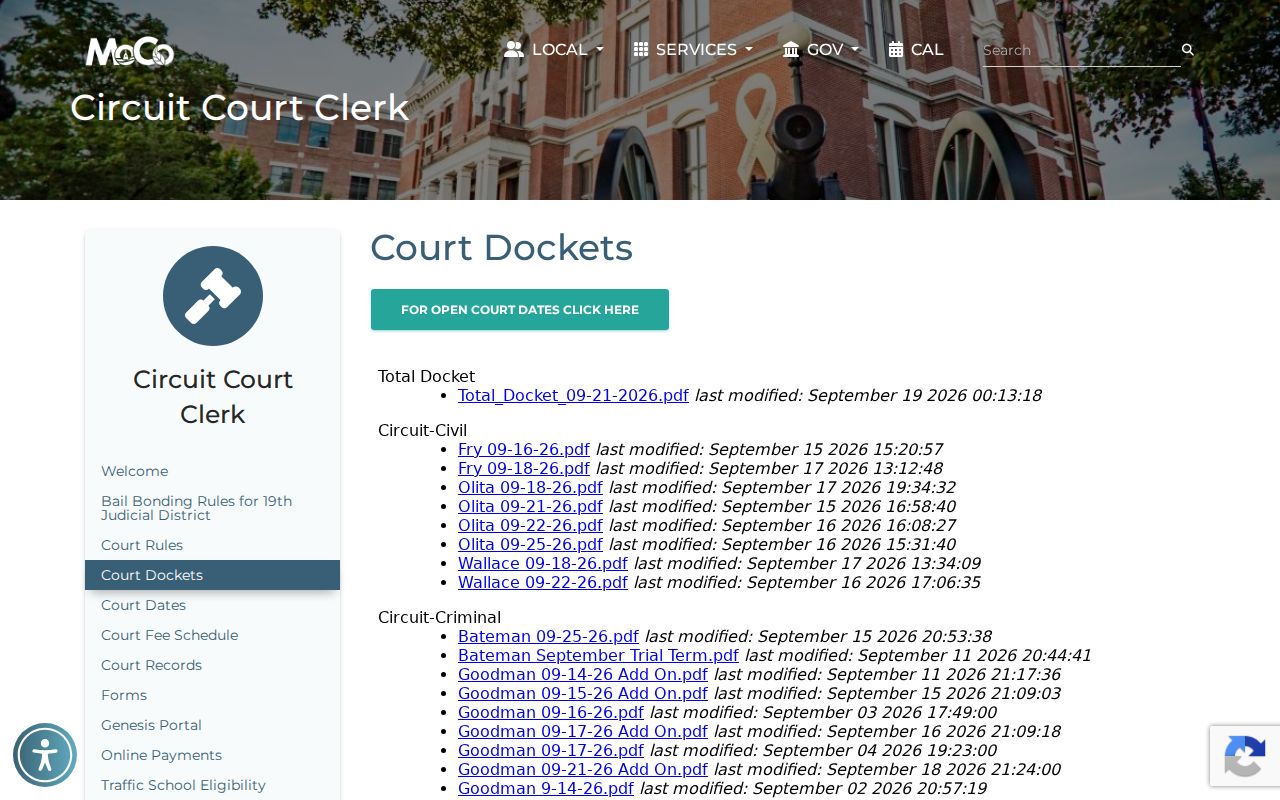
The county directory holds dated docket files, not a searchable warrant roster. Treat it as an index, not a warrant lookup. Montgomery County court records sit with the Circuit Court Clerk at 2 Millennium Plaza, Suite 115, Clarksville. Weekday hours run 8 a.m. to 4:30 p.m. Name the exact file or document in any public-record request. Sheriff-held records take a separate request route, and neither process guarantees release of restricted or redacted material.
Serving Arrest Warrants in Montgomery County
Arrest warrants in Montgomery County land with the Sheriff's Criminal Warrants Section. Staff check each warrant for completeness. Then they process it for service. Deputies try to locate the person and may work alongside other local, state, or federal agencies. The sheriff publishes no set service location or schedule. So never assume when an officer will act. Once a person named on a warrant is located, the county says deputies take that person to the jail for booking. Bond or a first appearance follows the court and case rules; for service questions, the sheriff's main office number is 931-648-0611, since there is no separate public warrant-unit line.
Montgomery County Fugitive Warrant Boundaries
Even joint service efforts leave records with each court. Start with the court named on the paperwork. The sheriff's local portal cannot speak for a federal warrant, a warrant from another county, or a Clarksville citation. Sheriff's deputies in Montgomery County assist federal, state, and local agencies with service and extradition. The Middle Tennessee Fugitive Task Force links local and federal enforcement. The portal covers county adult criminal warrants only. A federal matter belongs with the Middle District court, the U.S. Marshals, or counsel. A Clarksville citation is a separate animal. City tickets do not flow into the county arrest-warrant feed on their own. Ask the city clerk about a city ticket. For a county criminal docket, the Circuit Court Clerk is the right office. The office that issued the process controls the case. Federal docket information stays with the federal court. Check it there or through an attorney. The task force helps agencies coordinate arrests and extraditions, but it does not merge their databases, and no Montgomery County search result can confirm federal supervision, another county's case, or a sealed matter.
Comparing Arrest, Summons, and Bench Warrants
Under Tennessee Rule of Criminal Procedure 4, a court can issue either an arrest warrant or a summons on a complaint. The two call for different responses. A bench warrant is different again, a later court process tied to a missed duty or another case event. Montgomery County readers should check which instrument they face.
| Feature | Arrest Warrant | Summons | Bench Warrant |
|---|---|---|---|
| What it orders | Take a person into custody. | Appear in court without an arrest order. | Bring a person before the court after a case event. |
| Basis | Probable cause on a complaint. | Charge and court process under Rule 4. | Missed setting, contempt, or failure to comply. |
| Who issues it | Judicial commissioner or court. | Issuing court under the rule. | Judge or court handling the existing case. |
| How to respond | Confirm, get counsel, and follow the court's instructions. | Attend on the date shown. | Ask the issuing court about reset, recall, or hearing. |
Voluntary Appearance for a Montgomery County Warrant
Think an arrest warrant carries your name? Confirm it with the sheriff first, and identify the issuing court, before deciding how to appear. Montgomery County publishes no current surrender window, walk-in counter, processing time, or promise of release. Old walk-in service counts are not instructions for today. A lawyer can review the docket, contact the court, and discuss bond or a motion. The jail FAQ lists corporate, cash, and property bonds. It lists no public warrant-specific amount schedule. Never drive to the jail on the strength of a search screen alone. Court files and city tickets split too. Call the Circuit Court Clerk for a county docket. Ask that office about the next setting as well. For a Clarksville citation, the City Court Clerk holds the city record. The Sheriff's Office can speak to its own service information, so ask which office has the current action before you book travel or send money.
If There's an Arrest Warrant for You
Confirm the record before anything else. Call the Sheriff's Office and the Circuit Court Clerk, or whichever clerk issued the warrant. Ask what charge and case are tied to it. Ask about bond, holds, and required appearances. A search hit is not the signed affidavit packet, and a no-result is not proof that no warrant exists. Steps vary from there. For the county's wider resolution route, see the Montgomery County warrant overview. A lawyer can arrange a court appearance, move to recall or quash, or handle bond after an arrest. Montgomery County lists corporate, cash, and property bonds. The amount and terms depend on the case, and the court, not the public search form, decides whether its order changes.
Important: Contact counsel and the issuing court before appearing. The county does not publish a current surrender procedure or guaranteed release timetable.